The #1 Newsletter to keep you out of burnout forever!

Starting Over Is Not a Strategy
September 1, 2026
I once had a senior engineer rewrite the same integration four times in three weeks.
Each version looked cleaner than the last. None of them worked.
When I asked what was wrong with version three, he said “it just wasn’t right.” That was the whole answer. He couldn’t tell me what broke. He could only tell me it felt broken.
Something clicked for me that day that I’ve used ever since. When somebody restarts over and over, they’re rarely stuck on the solution. They’re stuck on the problem.
The Map Problem
Think of it like driving in a city you’ve never visited with no GPS. You take a street. Dead end. You back out and take a different street. Dead end again. By the fourth try you aren’t learning the city. You’re sampling roads.
Chi, Feltovich, and Glaser (1981) handed physics problems to experts and novices and asked them to sort the problems into groups. Novices sorted by what the problems looked like: pulleys here, ramps there. Experts sorted by the principle that actually solved them.
Same problems. Completely different filing cabinet.
When your filing system is wrong, every method you pull off the shelf is a coin flip.
Why Smart People Start Before They’re Ready
People believe they understand something until somebody makes them explain it step by step. Rozenblit and Keil (2002) called this the illusion of explanatory depth. Ask someone how a toilet works and they’re confident. Ask them to draw the mechanism and the confidence drains out.
That gap is where restarting lives.
It’s like when your knee hurts so you buy new running shoes. New shoes feel like action. The knee is still the knee.
The Ten Minute Test
Here’s what I do now instead of guessing. First, stop the person from working. Working is how the gap hides.
Then ask four things, all about the attempt they just abandoned, never about the next one:
- Explain the causal chain from where we are to what we want. No tools, no vendors, just how the thing works.
- Give me three lists. What must be true. What cannot be true. What you can’t tell yet.
- What did that last attempt rule out about the problem?
- You get one question for one expert. What is it?
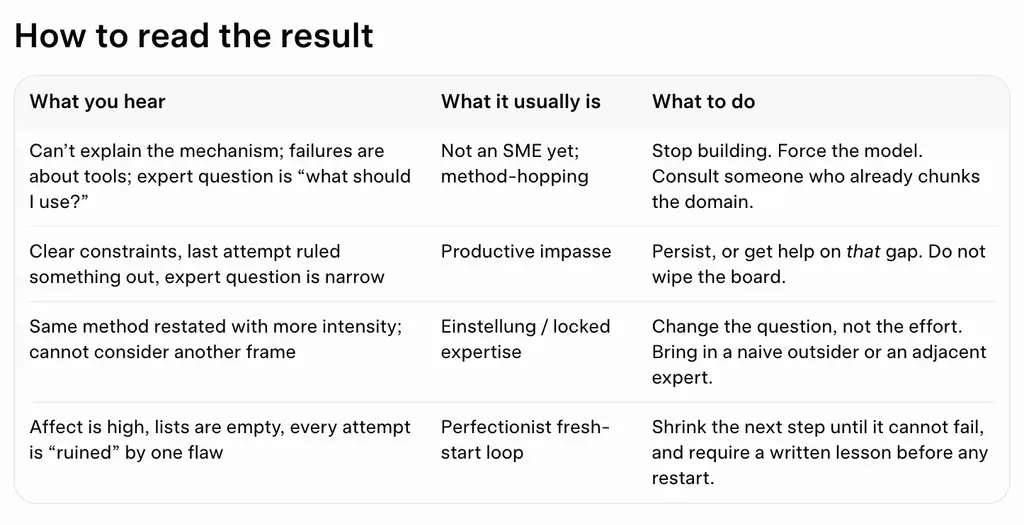
Watch the middle list. Somebody running from a thin model gives you a long “must,” an empty “cannot,” and a shrug.
What It Sounds Like
A guy on my team kept rebuilding a tool to flag at risk accounts. Spreadsheet first. Then a Notion board. Then a small app. He wanted an AI dashboard next.
So I asked what the Notion board ruled out.
“Reps hated filling it in.”
That’s a fact about a tool. It says nothing about risk.
What I wanted to hear was this: manual tagging failed because risk is a change in a pattern over time, not a label somebody slaps on once. That’s a real finding about the problem. He didn’t have it. Which meant version four was going to die the same way one through three did.
His expert question was “what’s the best way to build this in 2026?” That’s not a question. That’s a request for another restart.
The good version sounds different. Clear constraints. A named unknown. Something like “I still don’t know whether usage drop or losing our champion matters more, and that’s what I’d ask customer success.” That person is blocked on the problem. They shouldn’t wipe the board. They should keep going.
Kapur (2008) found that wrestling with a hard problem before instruction beats being taught the method first, but only when somebody names the structure afterward. Struggle with nothing on the other side is just struggle.
The Burnout Connection
Restarting drains people faster than hard work does. Hard work with a visible finish line is survivable. What wrecks you is effort that never converts into progress, because every reset erases the evidence that you were moving. Burnout isn’t fatigue. It’s a broken relationship with your environment and what you expect from tomorrow. Nothing poisons tomorrow faster than a Monday that looks exactly like the last four.
Your First Move
A one-line field test if you only have thirty seconds:
“Before you start over, tell me what the last version taught you about the problem that you would still believe if every tool on earth disappeared.”
If they cannot answer, they are not choosing a better path. They are trying to escape not knowing.
Ask yourself first. Then ask your team.Ask yourself first. Then ask your team.
Cheers, my friend!
Oliver
Wanna geek out?
Ackerman, R. (2014). The diminishing criterion model for metacognitive regulation of time investment. Journal of Experimental Psychology: General, 143(3), 1349–1368. https://doi.org/10.1037/a0035098
Chi, M. T. H., Feltovich, P. J., & Glaser, R. (1981). Categorization and representation of physics problems by experts and novices. Cognitive Science, 5(2), 121–152. https://doi.org/10.1207/s15516709cog0502_2
Kapur, M. (2008). Productive failure. Cognition and Instruction, 26(3), 379–424. https://doi.org/10.1080/07370000802212669
Rozenblit, L., & Keil, F. (2002). The misunderstood limits of folk science: An illusion of explanatory depth. Cognitive Science, 26(5), 521–562. https://doi.org/10.1207/s15516709cog2605_1

Podcast Episodes

Listen to my latest podcast episodes and learn about career success and a life without burnout.
Click to listen on Apple Podcasts and Spotify:


Join 87.4k professionals and get your Burnout Score:
Dr. Degnan's Burnout Score is a scientific first step for you to reverse and prevent burnout forever. After that, join 2.3k professionals and take my masterclass, NEVER BURNOUT AGAIN, and reverse burnout forever in less than 20 days.
GET MY BURNOUT SCORE