The #1 Newsletter to keep you out of burnout forever!


Executive AI Is Cutting Out the Middle
March 3, 2026
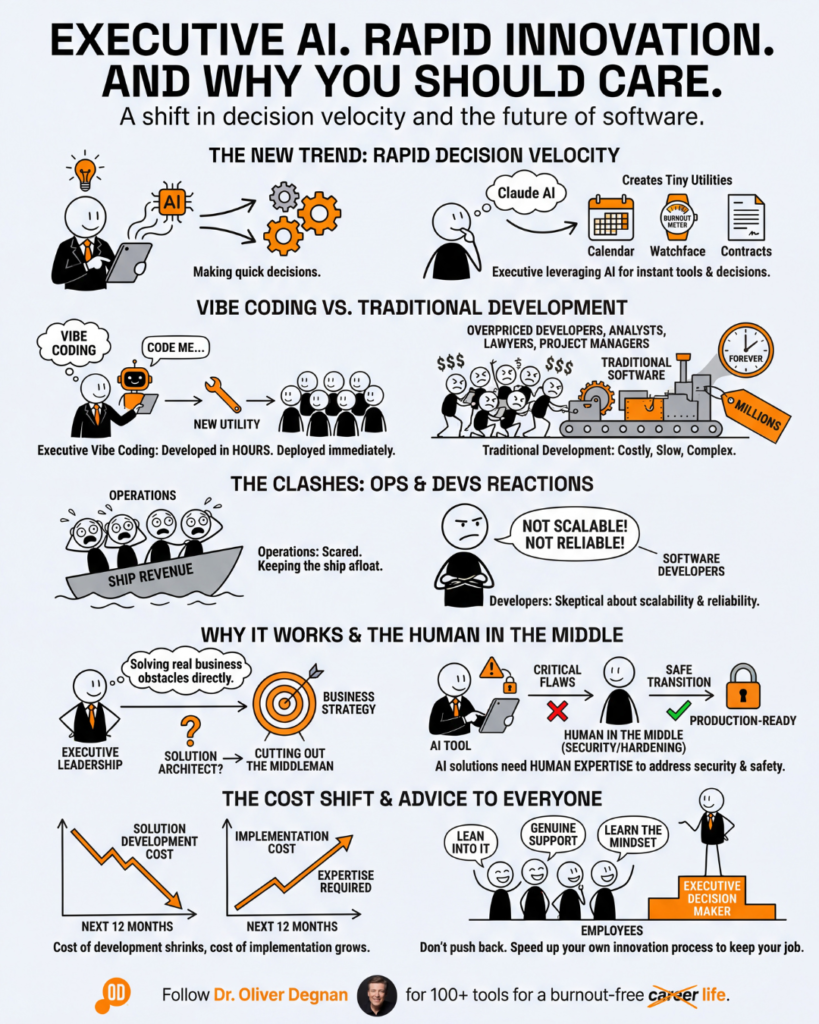
Last week, I built a Chrome extension in two hours. No developers. No project plan. No budget approval. Just me and an AI.
A few years ago, that same tool would have cost six figures. It would have taken months. I would have needed a solution architect, a project manager, and a dev team.
Now I do it before lunch.
And I am not the only one. Every day, I use AI to write small utilities. Tools that manage my calendar. Apps that handle new client contracts. Even a Garmin watchface that tracks my burnout levels.
When did this become normal?
I see the same thing with my C-suite clients. They build small apps in hours and send them to their teams the same day. Problems that sat in a backlog for months get solved on a Tuesday afternoon.
This is Executive AI.
The architect is gone
Here is what changed. Executives sit closest to the strategy. They know what problems block revenue. They feel the friction every day.
In the old days, they needed a translator. A solution architect sat between the business need and the technology. Their whole job was alignment. Make sure tech matched the goal.
AI removed that step. Now the executive thinks of a solution and builds it. No translation layer. No six-month timeline. No budget fight.
The operations people are watching. And they are nervous. They keep the ship running in any weather. Sudden change from the top makes their job harder. Software developers push back too. They say these vibe-coded tools are not scalable. They say we still need them. They might be right. For now.
The security problem nobody mentions
When I built that Chrome extension, I asked the AI to check for security flaws. It found a dozen critical issues. It fixed every one of them.
But I had to remember to ask.
The first version looked polished. It worked great. And it would have exposed sensitive data to anyone who tried. This is the part that gets skipped. Everyone celebrates the speed. Nobody talks about the risk.
What if the new executive skill is not coding? What if it is knowing what questions to ask after the code is written?
Building costs will drop to near zero in the next twelve months. Making those builds production-ready will cost more. That gap is where the real value lives. We still need a human in the middle. Not to write the code. To make sure it does not break everything.
The Burnout Connection
Speed creates a trap. When you can build anything in hours, you feel pressure to build everything.
Executives already carry heavy decision fatigue. Now add the dopamine hit of instant creation. Your brain treats every new idea as urgent. Shipping something fast feels so good that you reach for more.
This is how a powerful new tool becomes a new source of exhaustion. The speed is real. So is the cost to your nervous system.
Lean in or fall behind
If you work in operations or development, resist the urge to push back. Executives building with AI are trying to keep the business competitive. That effort keeps you employed.
Instead, become the person who makes their solutions safe. Learn how AI works. Ask to be part of the testing process. Show genuine interest in what they build. That is how you protect your role.
For executives, slow down long enough to ask the hard questions. Does this handle edge cases? Did I check for security? Is my team ready to support this in production?
Download the Burnout Recovery Field Guide and start building the habits that protect your energy while you lead through rapid change.
Build fast. Then build it right.

Podcast Episodes

Listen to my latest podcast episodes and learn about career success and a life without burnout.
Click to listen on Apple Podcasts and Spotify:


Join 87.4k professionals and get your Burnout Score:
Dr. Degnan's Burnout Score is a scientific first step for you to reverse and prevent burnout forever. After that, join 2.3k professionals and take my masterclass, NEVER BURNOUT AGAIN, and reverse burnout forever in less than 20 days.
GET MY BURNOUT SCORE