The #1 Newsletter to keep you out of burnout forever!

The Science of Being Late, Notoriously.
March 23, 2026
Late again. The room goes quiet for a half-second. Everyone notices.
He just can’t be on time. So disrespectful.
That’s the story we tell. It feels true. It feels obvious.
But here’s the problem. It’s usually wrong.
Chronic lateness almost never comes from disrespect. It comes from a brain running on broken math — and if you keep treating it like a character flaw, you’ll keep getting nowhere.
This is The Clock Problem.
The science behind the tardiness
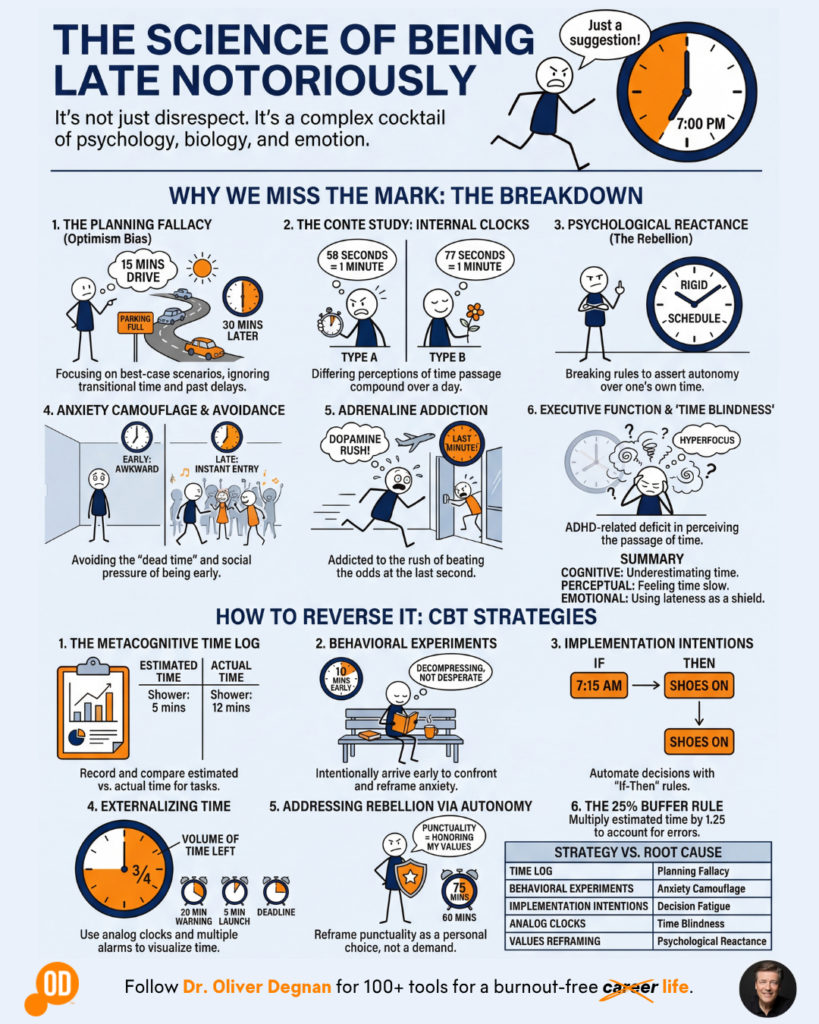
In 2001, psychologist Jeff Conte at San Diego State ran a landmark study on personality types. He found that Type B personalities perceive a minute as 77 seconds. Type A personalities feel it at 58 seconds.
That 19-second gap sounds small. Compound it across a workday and you’re operating on a completely different clock than everyone else in the room.
Some people are not choosing to be late. They genuinely believe they have more time than they do.
Cognitive psychologists Daniel Kahneman and Amos Tversky called the planning side of this the Planning Fallacy. You predict the best case. Reality delivers the average case. The gap bites you every time — and you never learn from it.
What you’re probably getting wrong
When someone on your team is chronically late, the first instinct is frustration. That’s understandable. But it’s also ineffective.
There are four common roots: bad time math, a slow internal clock, anxiety about arriving early, and — this one surprises people — an unconscious need for control. Psychologist Jack Brehm’s Reactance Theory explains it. Rigid schedules can feel like a threat to autonomy. So some people push back. Not consciously. Just quietly.
ADHD adds another layer. Psychologist Russell Barkley calls it time blindness. The prefrontal cortex doesn’t reliably sequence time. Hyperfocus kicks in, the outside world disappears, and twenty minutes vanish. That’s not defiance. That’s neurology.
Diagnosing the root correctly changes everything about how you respond.
The Burnout Connection
Chronic lateness isn’t just a scheduling problem. It’s often a stress signal.
Psychologist Joseph Ferrari found that some people are arousal procrastinators — they need the pressure of being late to generate enough dopamine to move at all. Rushing in at the last second feels like urgency. But urgency is just adrenaline dressed up as productivity. Every rushed entry is a cortisol spike. Every missed preparation window is compounding cognitive debt.
When leaders normalize this pattern — in themselves or their teams — they’re normalizing a slow energy drain. The brain cannot sprint to every starting line and still have fuel for the actual race.
What actually works
For the people on your team, start with curiosity instead of consequences. Ask privately: “I’ve noticed you tend to arrive after things start. Is there something getting in the way I can help remove?” You might find back-to-back meetings with no buffer. Social anxiety about idle pre-meeting small talk. Or a commute that’s genuinely unpredictable.
Then help them build external systems. Research by Peter Gollwitzer shows that “if-then” implementation intentions dramatically outperform vague goals. “I want to be on time” is weak. “If it’s 8:45, I’m walking to the door” is wired directly into behavior. Encourage three alarms: one warning 20 minutes out, one launch alarm 5 minutes out, one hard deadline. Not one alarm. Three.
For your own pattern: try the 25% buffer rule. Calculate how long you think something will take. Add 25%. Your brain will resist this. Do it anyway. The data almost always proves you right.
Punctuality isn’t about the clock. It’s about the respect you have for your own word.
Want more evidence-based strategies for high performance without the burnout? Download the Burnout Recovery Field Guide at https://neverburnoutagain.com/burnout-field-guide.

Podcast Episodes

Listen to my latest podcast episodes and learn about career success and a life without burnout.
Click to listen on Apple Podcasts and Spotify:


Join 87.4k professionals and get your Burnout Score:
Dr. Degnan's Burnout Score is a scientific first step for you to reverse and prevent burnout forever. After that, join 2.3k professionals and take my masterclass, NEVER BURNOUT AGAIN, and reverse burnout forever in less than 20 days.
GET MY BURNOUT SCORE