The #1 Newsletter to keep you out of burnout forever!
Why is it so hard for me to find a new job?
June 23, 2024
Apr 7, 2024
Why is it so hard for me to find a new Job?
Hi there,
Whether you’re desperate to escape a toxic workplace, need a pay raise, see no promotion in sight, or are facing layoffs, job hunting in 2024 is a new game. It’s nothing like it was a decade ago or even pre-COVID and pre-AI.
You have 3 options to go about finding a new job:
Send out my resume to hundreds and thousands of companies and wait to get a call
Call a guy I know who has a job for me
Turn my job search into my business
Option #1 is the traditional and ancient way of hoping to get lucky in your pursuit of happiness. You are a tiny fish in an ocean of sharks.
Option #2 is for the ones who have done a good job maintaining relationships over the years. This takes years!
Option #3 involves putting your leadership skills into practice and creating a business plan for finding your job. This business plan should include your job search objectives, strategies, and tactics, as well as a timeline and a budget. It’s about being proactive, strategic, and resourceful in your approach to finding a job.
Forget options #1 and #2. Let’s equip you with more control and capability through option #3.
I need you to have the attitude of not waiting for handouts but going and getting what you want.
From now on, your job search, heck – your life affairs – are your business, and I mean literally your business.
Take a business approach to finding your ideal employer and your next role. This means conducting market research to identify potential employers, developing a marketing strategy to promote your skills and experience, and setting clear objectives and key metrics to track your progress.
It’s time to test your leadership.
In leadership, every initiative has:
an objective that will be measured
a budget
a team
a project plan
Let’s apply this to your job search.
The Objective
Your objective is not to find a job. Instead, it is to find suitable companies and get interviews. This is a mindset shift in how you approach the challenge!
Your key metrics are:
#Employers: Number of potential employers identified
#Interviews: Number of interviews secured
#Outreaches: Number of times you’ve contacted potential employers for an interview
Key metrics are the specific measurements you use to track your progress and success. In the context of job search, these metrics can include the number of potential employers identified, the number of interviews secured, and the number of times you’ve contacted potential employers for an interview. By tracking these metrics, you can see how effective your job search strategies are and make adjustments as needed.
And this will blow your mind: you have a budget for your job search endeavor. In this context, a budget refers to the resources (time, money, energy) you’re willing to invest in your job search. It’s about setting priorities and making strategic decisions about how you allocate your resources to maximize your chances of finding a job.
You are an executive leader. Everything you do must add strategic long-term value.
So, your job search is not just a project; it’s a strategic initiative that demands meticulous planning and execution.
Set yourself a budget for the team and tools you will need to find new employment quickly.
A Real-World Example
Here is a conversation I had with a client of mine who was sending out resumes unsuccessfully for 7 months and then called me for help:
James:“I am desperate at this point. I have been applying for hundreds of jobs and calling everyone for the past seven months, but I have not had a single interview.”
Oliver:“Who is helping you with your job search?”
James:“I used a resume writing service to update my resume.”
Oliver:“How soon do you need to find new employment?”
James:“Really, as soon as possible. I am low on my savings at this point. If I don’t find a job in the next 1-2 months, I have to sell my house.”
Oliver:“What’s your budget for finding a job?”
James:“What do you mean?”
Oliver:“You need to build and lead a team to help you find a job in the next two months. That team will cost money.”
James:“Oh man! I never looked at it this way.”
James and I went on to set the initial budget to $1,500 and the goal to find a new job in the next 2 months. Here is what James did:
Got the free version of HubSpot to set up his “Job Search Pipeline”
Got the paid LinkedIn Sales Navigator subscription ($99/mo); Forget LinkedIn Premium! It’s useless to find a job!
Got a paid account to SalesQL.com ($39/mo): This tool gets you the real phone numbers and email addresses of the decision-makers
Got a social media analyst in India via fiverr.com ($300/mo)
Got a subscription to Chat-GPT ($20/mo) for communication and content
Hired a sales freelancer ($800/mo)
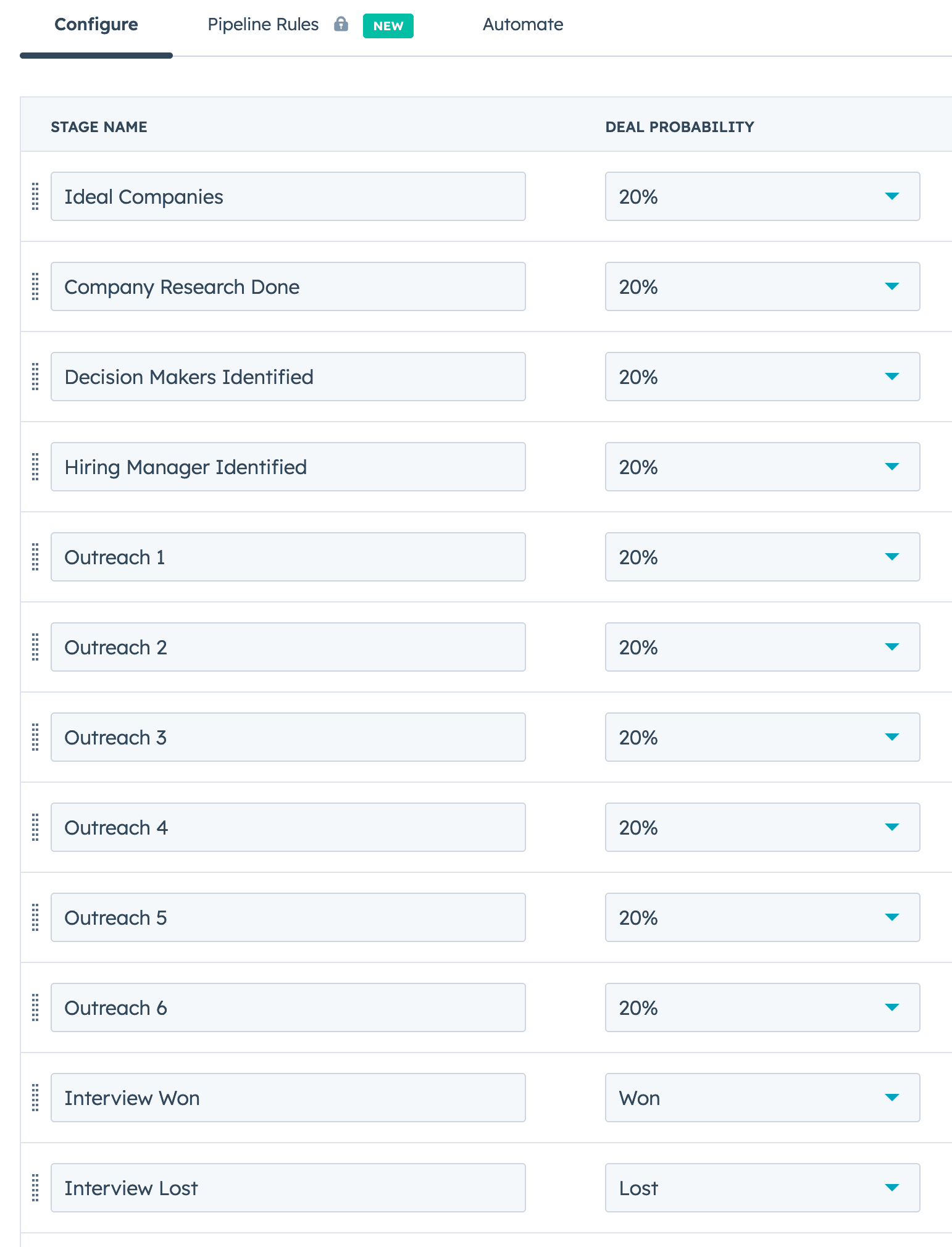
Here is what his Job Search Pipeline looked like in HubSpot:
Note: We also added some custom properties and logic to the pipeline, company, and contact records. Hit me up on LinkedIn, and I will send you detailed instructions on how to set all of this up.
Then, he used my LevelUp System to 10x his productivity, which includes a bonus module for a structured approach to executive job searching. This system helped him free up all his time and create an intense focus on filling his HubSpot job search pipeline with ideal companies, decision-makers, and hiring managers.
The job search pipeline is a systematic way of organizing your job search, from identifying potential employers to securing interviews. It’s a tool that helps you stay organized, track your progress, and ensure you’re targeting the right opportunities. It’s like a sales funnel for your job search, guiding you from the initial research phase to the final interview stage.
Weekly, he reflected on what worked well and where to improve based on what the numbers told him. He got more effective every week.
During the interviews, he also [occasionally, when appropriate] disclosed his job search strategy to potential employers, which demonstrated his leadership and strategic problem-solving skills. The hiring manager at Amazon was so impressed with his approach that, in his own words, it “was a no-brainer to hire James on the spot.”
The Result for James
“I was without a job for 7 months, sending out countless resumes without receiving a single call back for an interview. I felt depressed and ready to give up. Then I called Oliver, and he showed me a better way. After 2 weeks, I had 3 interviews lined up. And after 6 weeks, I had 3 job offers in my hand.” ~James G., VP of Engineering
The Critical Takeaways
1️⃣ The traditional job search is [almost] dead. Stop spinning your wheels and become more methodical and strategic in your job search.
2️⃣ Stay in control of your job search. Don’t wait on recruiters and job boards.
3️⃣ Always build a [paid] team to help you achieve your goals. This team can include professionals like resume writers, sales professionals, career coaches, and job search strategists. Remember, you’re not alone in this. Business Tip: You want to pay for your team to ensure you control their time and deliverables.
4️⃣ Looking for new employment is an excellent opportunity to showcase your leadership and business skills and put your experience into action.
5️⃣ Great leadership always starts by building an effective team, business/project plan, and system to achieve the set objectives.
6️⃣ During your job search, work the numbers (metrics) and celebrate weekly achievements. No job search on the weekend!
Your job search initiative is your business. Literally, run it as such.
Reversing burnout starts by knowing how much you’re currently dealing with burnout. 🔥 🔥 Go ahead and take my free burnout assessment right now: https://burnout.drdegnan.com.
If you are a leader, inquire about my “LEVEL-UP System,” which will empower you to become ultra-productive without burning out. Send your inquiry to inquiry@drdegnan.com.
If you want to get promoted into executive leadership, inquire about my proven step-by-step guide to advancing to the C-suite at https://drdegnan.com/coaching.
Leadership is hard. We spend a lifetime perfecting to lead teams and organizations with tangible results that change people’s lives.
Let’s make sure we get it right without burning out.
Hi, I’m Oliver.
I have been living in the trenches of a C-suite leader for over 17 years, leading thousands of employees between Startups, PE, and Fortune 50 companies. I am the former SVP and CTO for IBM Watson Health, Chief Architect for Intuit in Silicon Valley, and founder of MoreTalent AI with a successful exit in the 7-figure range. Every newsletter I send out has invaluable insight to help you succeed in your journey.
Listen to my latest podcast episodes and learn about career success and a life without burnout.
Click to listen on Apple Podcasts and Spotify:
Join 87.4k professionals and get your Burnout Score:
Dr. Degnan's Burnout Score is a scientific first step for you to reverse and prevent burnout forever. After that, join 2.3k professionals and take my masterclass, NEVER BURNOUT AGAIN, and reverse burnout forever in less than 20 days.